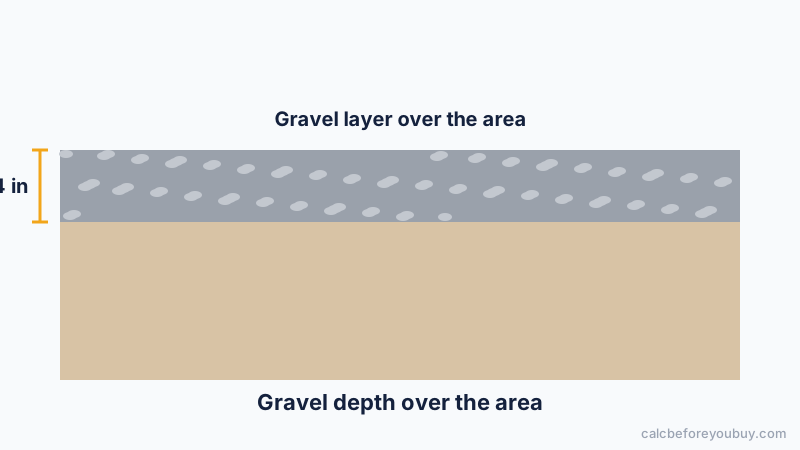
How the gravel calculator works
Quarries and landscape suppliers usually sell gravel by the ton, while you measure your project in feet — so the calculator converts volume to weight using a typical density for the material you choose.
How deep should gravel be?
| Project | Typical depth |
|---|---|
| Walkway or garden path | 2–3 in |
| Decorative cover over fabric | 2–3 in |
| Patio or paver base | 4–6 in compacted |
| Gravel driveway (top layers) | 4–6 in |
| New driveway over soft soil | 8–12 in in layers |
Why add extra?
Crushed stone and road base compact when you run a plate compactor or drive on them, so the finished layer is thinner than the loose material you spread. Adding 10–15% covers compaction and spillage.
Choosing the right gravel
- Crusher run / road base packs tight — best for driveway bases and under pavers.
- #57 crushed stone drains well — good for drainage, driveway top layers and under sheds.
- Pea gravel is smooth and comfortable to walk on, but shifts under car tires.
Frequently asked questions
How much does a cubic yard of gravel weigh?
Typically 1.3–1.5 tons (2,600–3,000 lb), depending on the stone and moisture.
How many tons of gravel for a driveway?
A 12×50 ft driveway at 4 inches with 10% extra is about 8.1 cubic yards, or roughly 11–12 tons of crushed stone.
How much area does a ton of gravel cover?
For a typical gravel at 1.4 tons per cubic yard, one ton covers about 115 square feet at 2 inches deep or about 58 square feet at 4 inches.
How many bags of gravel in a yard?
About 54 bags of 0.5 cubic feet (the common 50 lb bag size).