How the tile calculator works
Grout joints are ignored on purpose. They make the real coverage slightly larger than the tile face, which gives you a small extra margin.
How much extra tile to buy
Buy 10% extra for a standard straight layout. Go to 15% for diagonal layouts, rooms with many corners and large-format tiles (they waste more per cut), and 20% for herringbone. Check that every box has the same lot or batch number — shades vary between production runs.
Tiles per square foot
| Tile size | Tiles per sq ft | Sq ft per tile |
|---|---|---|
| 3×6 in (subway) | 8 | 0.125 |
| 4×4 in | 9 | 0.111 |
| 6×6 in | 4 | 0.25 |
| 6×24 in (wood-look plank) | 1 | 1 |
| 12×12 in | 1 | 1 |
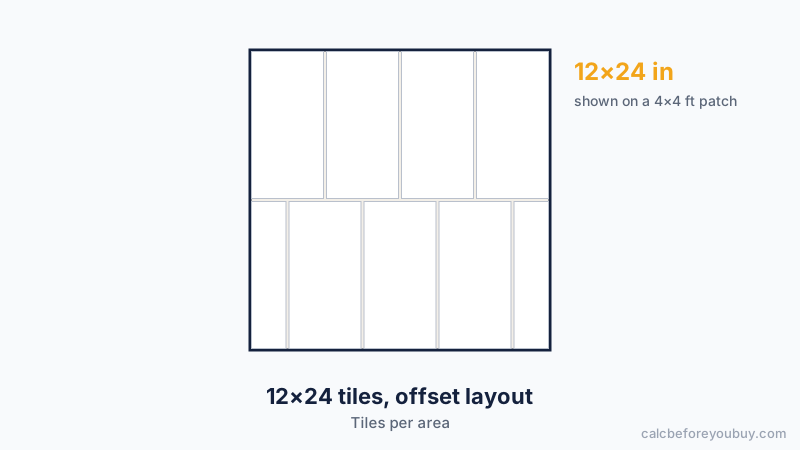
| 12×24 in | 0.5 | 2 |
| 18×18 in | 0.44 | 2.25 |
| 24×24 in | 0.25 | 4 |
| 24×48 in | 0.13 | 8 |
Measuring walls and showers
For walls, multiply the width of each wall by the height you'll tile, then subtract windows or niches. For a backsplash, measure the length of the counter run times the backsplash height (often 18 inches = 1.5 ft).
Frequently asked questions
How many 12x24 tiles do I need for 100 square feet?
50 tiles exactly, or 55 tiles with 10% waste. Each 12×24 tile covers 2 square feet.
How many subway tiles per square foot?
3×6 inch subway tile is 8 tiles per square foot.
Should I include grout lines?
No. Calculating with the tile size alone gives a slight extra margin, which is helpful.